Create your own assay or use established assays such as ELIspot and Fluorospot
ELIspot / fluorospot
Antigen specific T cell reactions can provide pivotal information on (therapeutic) vaccine response. ELIspot or Fluorospot is a very robust method to measure the number of cytokine producing cells in a culture. And is often used a s a biomarker for T cell responses to a vaccine or other immune modulating therapies.
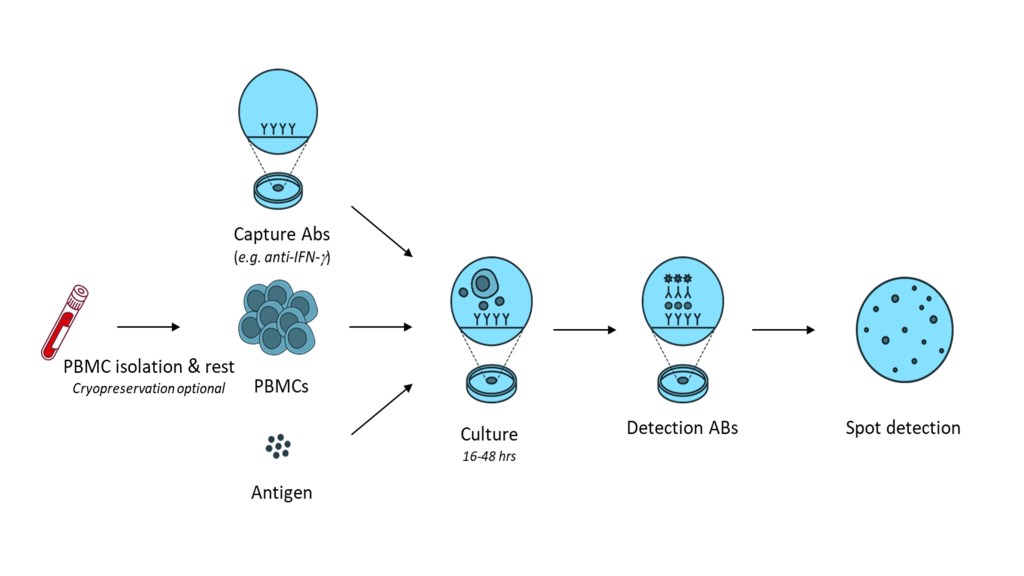
Cryopreserved or fresh PBMC can be stimulated with an antigen or peptide mix to elicit a T cell response overnight in culture. Upon TCR specific stimulation, cytokines will be produced and captured on the antibody coated ELIspot well. After incubation, cells are washed away and spots can be visualized by adding a detection antibody that can elicit and enzymatic reaction (ELIspot) or has a fluorophore attached (Fluorospot). Each spot represents an activated T cell and can be quantified using an ELIspot reader.

Using Fluorospot, multiple cytokines can be detected, providing valuable information on the polyfunctionality of the cells.
Functional assays

Basophil Activation Test
Screen your therapeutic on inhibition of basophil activation via our whole blood based assay. Our flow cytometry based assay uses CD63 expression as a readout for activation.
MoDC generation
Monocyte derived Dendritic Cell (moDC) generation can be the basis of an autologous or allogeneic T cell activation assay but also a way to measure the potency of a vaccine adjuvant, or unwanted immune responses.
Phagocytosis assay
Are macrophages clearing your therapeutic? Or influencing the phagocytic capacity of immune cells? Our flow cytometry and microscopy facilities are state of the art and well equiped to help enravel your phagocytosis questions.
Migration Assay
Do your drugs interfere with the capacity of Dendritic Cells to migrate? Use our transwell set up measure the influence of migrating towards a chemoattractant.
Cytokine production
Measure unwanted immune activation in our whole blood system or monitor immune responses in clinical samples. We can use ELISA, Flow based and other methods to monitor immune responses based on cytokine production.
NETosis
Is your therapy inhibiting or inducing NETosis? We can quantify neutrophil extracellular trap (NET) formation to further your neutrophil research.
Custom assays
Considering the extensive knowledge and expertise of the professionals linked to us, we are your ideal partner to elucidate the mechanism(s) of action of your therapy. We offer off the shelf solutions such as extensive immune monitoring panels for your questions during the clinical phase Alternatively, we can develop an extensive co-development trajectory, to examine the mode of action of your drug or treatment in more detail and help de-risk your project. All assays can be adapted to your specific research question and needs.
References
van Pul KM, Vuylsteke RJCLM, de Beijer MTA, van de Ven R, van den Tol MP, Stockmann HBAC, de Gruijl TD. Breast cancer-induced immune suppression in the sentinel lymph node is effectively countered by CpG-B in conjunction with inhibition of the JAK2/STAT3 pathway. J Immunother Cancer. 2020 Oct;8(2):e000761. doi: 10.1136/jitc-2020-000761. PMID: 33046620; PMCID: PMC7552844.
Freen-van Heeren, J.J. et al. (2024). Assessing Antigen-Specific T Cell Responses Through IFN-γ Enzyme-Linked Immune Absorbent Spot (ELISpot). In: Kumar, V. (eds) Immune Homeostasis. Methods in Molecular Biology, vol 2782. Humana, New York, NY. https://doi.org/10.1007/978-1-0716-3754-8_17
 Immune Monitoring Services